Local and Cloud Handoff
Move work across environments without losing reviewability.
Use the right surface
After this you can pick Local/cloud handoff for the right job and define done.
Done means you can hand off cleanly and keep the diff reviewable.
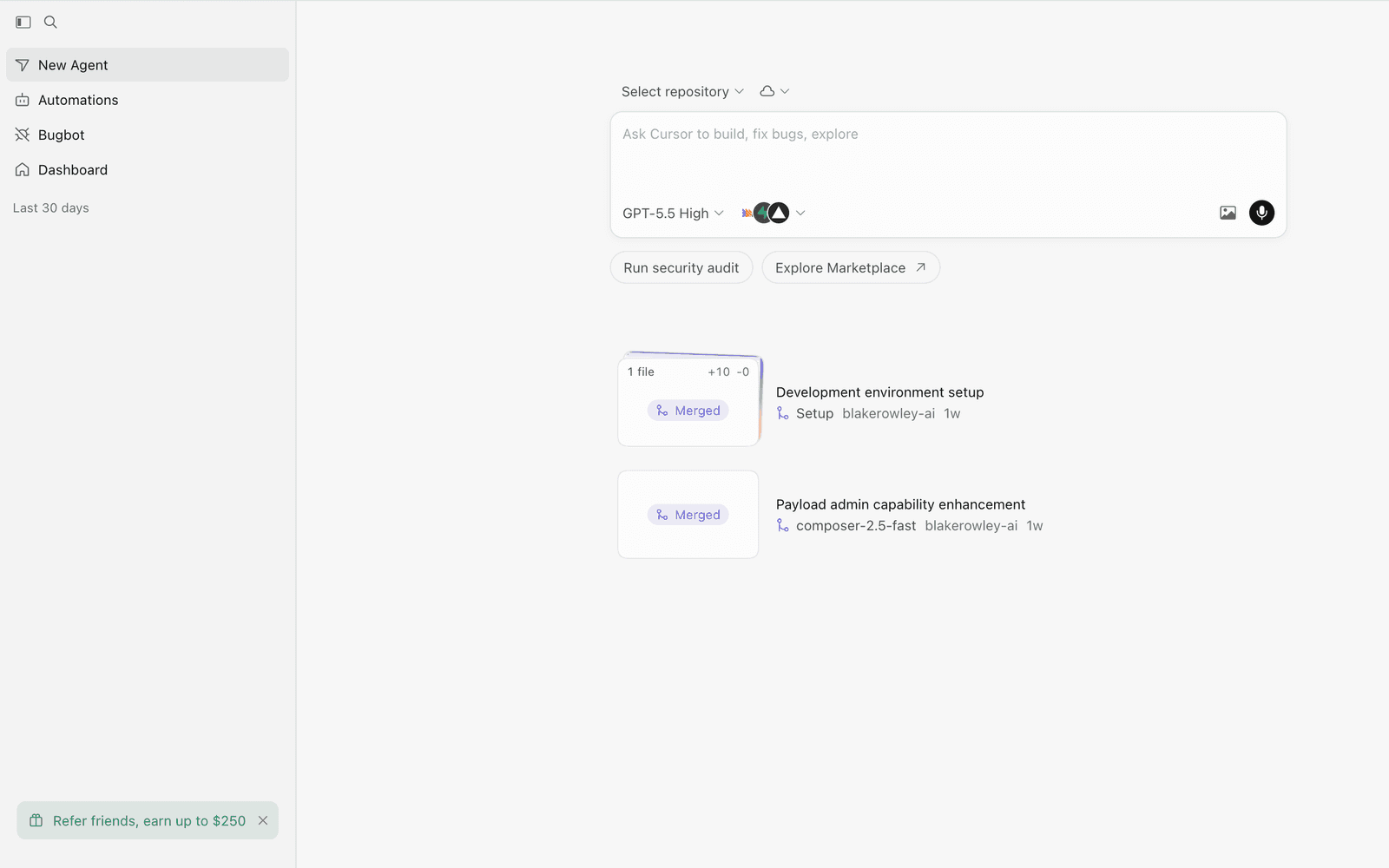
Cloud agents help when work needs isolation, artifacts, handoff or parallel execution.
Use Local/cloud handoff when a task starts in one environment but should finish or verify in another. Keep the boundary narrow.
Start small. Name the job, attach the context that proves the point and decide what evidence would make the output trustworthy.
Read the loop before touching the controls. The first beat frames the work, the second uses Cursor, the third checks the result and the fourth leaves a handoff someone else can inspect.
Interactive diagram. Tab through its regions; each focused region shows its detail in the panel below.
Run this loop in a real repo.
- Entry point
- Agents Window handoff and cloud/local branch workflow
- Source
- Cloud AgentsAgents that run in a Cursor-managed virtual machine, check out the repo, do the work and open a pull request, then shut down, with no load on your laptop., Agents Window docs and June 2026 handoff changelog
Use the source as the product reference.
Ask Cursor for an output you can inspect.
If the output cannot be checked, narrow the task before you continue.
A good run leaves a file, setting, screenshot, command result or written claim you can verify.
Takeaway. Done means you can hand off cleanly and keep the diff reviewable.
Self-check
QWhen should you reach for Local/cloud handoff?
Run it
After this you can do the task with clear scope and one proof point.
Treat this as a short practice loop, not a product tour. The task should be small enough that you can inspect the result without trusting the summary.
- 1Summarize the current state and what remains.
- 2Send the task to the environment best suited for the remaining work without losing branch or PR expectations.
- 3Keep branch, test and PR expectations explicit.
- 4Pull the result back and run the local checks that matter.
The exercise is complete only when the proof matches the requested outcome. If the proof is weak, reduce the scope or fix the context instead of adding more instructions.
Keep the task small enough to review.
The branch history remains understandable.
Takeaway. Stop when you have proof: The receiving environment has enough context..
Self-check
QWhich habit makes this workflow safe to use on a real project?
Check it
After this you can find the first failed check before changing tools.
Verification decides the next move.
Interactive diagram. Tab through its regions; each focused region shows its detail in the panel below.
Pick a row to see what to look for.
Use the first failure signal as the next prompt. Broad retries usually make the run noisier; a narrow retry gives Cursor a concrete repair target.
No proof means more checking.
Use a real repo or admin setting. Save the prompt, context and proof.
Takeaway. If it fails, find the first failed check.
Self-check
QThe workflow failed. What is the best first move?