For Teams
AI Coding Policy + ROI Template for Teams Adopting Cursor
A good AI-coding policy answers five questions in one page: which models are allowed, who pays and how spend is capped, what data may go in prompts, how AI-generated code is reviewed and who resolves conflicts. Pair it with an ROI baseline (time saved, PR throughput, cost per dev) so the rollout is measured, not assumed.
On this page
What goes in an AI coding policy?
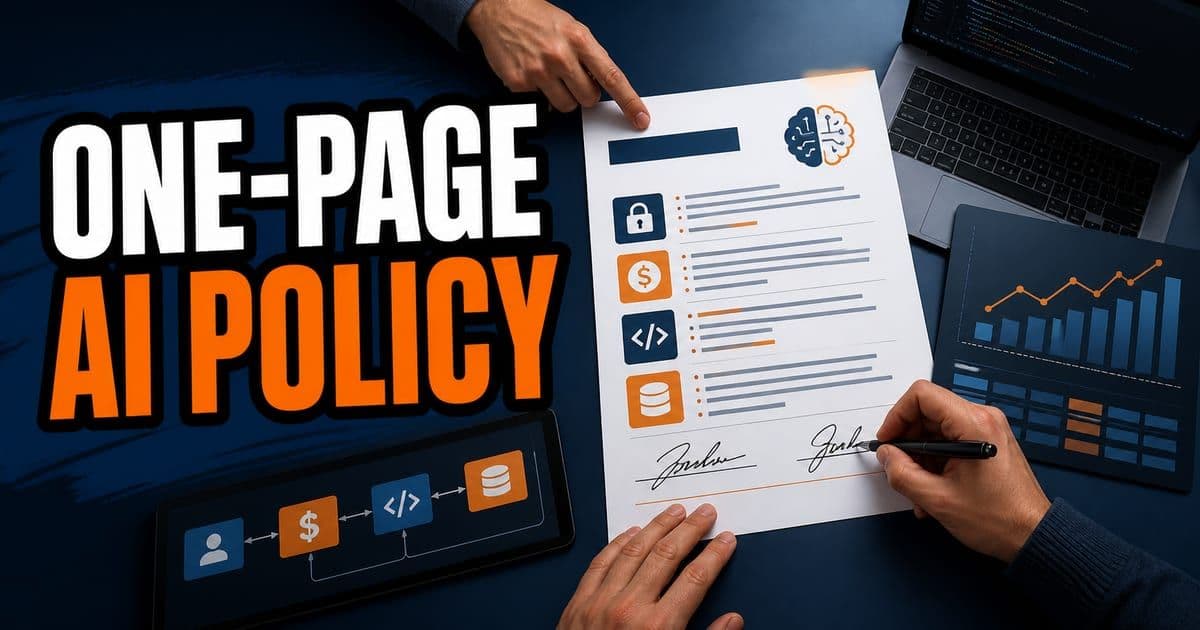
A workable policy answers five questions and stops there: which models are approved, who pays and how spend is capped, what data may go in a prompt, how AI-generated code is reviewed and who breaks a tie when a reviewer and the AI disagree.
- Model access
- Which models are approved; defaults by task and team.
- Spend & caps
- Who pays, seat types, whether on-demand usage is enabled, team-wide monthly spending limit.
- Data handling
- Privacy ModeCursor's setting that guarantees code data is not used for training by Cursor or its model providers, and that an admin can enforce org-wide; data-retention terms are a separate, contractual layer. Press Enter for the full definition. enforced; no secrets/PIIPersonally Identifiable Information. Data that can identify a person (names, emails, SSNs); regulated and sensitive. Press Enter for the full definition. in prompts;
.cursorignorefor sensitive paths. - Review rules
- AI-generated code is reviewed like any other; author stays accountable.
- Conflict resolution
- Who decides when AI output and a human reviewer disagree.
Five is not a magic number, it is the number that fits on one page, and length is what decides whether anyone reads the thing. The part teams leave out is conflict resolution, probably because it looks like the least technical of the five. Then a reviewer blocks a PR because they do not trust an agent-written migration, the author points at the passing tests, and nobody has been named to break the tie.
Model access is the line most likely to end up aspirational. Cursor documents group-scoped model access under Organization Groups on Enterprise, where group settings combine permissively with team settings: restrictive defaults at the team level, widened for the cohorts that need more. Check what your own dashboard exposes before you write that line as a control, and phrase it as a default people follow when it is not one.
Teams billing is seat plus usage: each Standard or Premium seat includes monthly usage across the Cursor ModelsCursor's plan and usage pool for models it labels as Cursor Models, kept separate from the third-party Other Models pool. Press Enter for the full definition. and Other ModelsCursor's pool of supported third-party models from providers such as Anthropic, Google and OpenAI, with separate plan access and usage from Cursor Models. Press Enter for the full definition. pools. Cursor Models currently contains Grok 4.6A Cursor and SpaceXAI frontier model for complex coding and knowledge work; it is a selectable model and is separate from the Grok Bot product. Press Enter for the full definition., Grok 4.5 and Composer 2.5The current Composer release, better at long-running tasks and at judging when a job needs a light touch versus deep work. Press Enter for the full definition.. Other Models covers third-party requests at list API prices plus the Cursor Token Rate. Auto is a Router mode with separate billing rules, not a model in either pool. Usage past the included pools continues as on-demand usage billed in arrears, so the policy should name the monthly team-wide spending limit set in the dashboard. Per-member limits and pooled usage are Enterprise features.
The consequence of that callout is easy to miss. On Teams the only hard spending control is team-wide, because per-member limits are Enterprise. Included usage is allocated per person and does not transfer, so nobody can eat a teammate's allowance. On-demand spend behaves differently: it draws against the same team-wide cap for everyone, which is why the spend paragraph earns its place even when the dashboard number looks generous.
Policies people actually follow are short. Five clear rules beat a 12-page document no engineer reads. Put it in the repo and link it from onboarding.
This is covered hands-on in Teams and Enterprise Admin — 6 short Units, free to read.
Rather do it than read about it? Run 11 interactive Cursor walkthroughs in a simulated editor. Free, no account needed.
What are the must-have data rules?
These are the data rules security and finance will check for. Each one keeps sensitive material out of prompts and training data, and they are short enough to fit on the same page as the rest of the policy.
- Enforce Privacy ModeCursor's setting that guarantees code data is not used for training by Cursor or its model providers, and that an admin can enforce org-wide; data-retention terms are a separate, contractual layer. Press Enter for the full definition. org-wide so code is never used for training.
- No secrets or PIIPersonally Identifiable Information. Data that can identify a person (names, emails, SSNs); regulated and sensitive. Press Enter for the full definition. in prompts: keys, tokens, customer data stay out of chats.
- Use `.cursorignoreA file listing paths Cursor must never index or read, kept separate from .gitignore. Press Enter for the full definition.` for sensitive paths (treat it as best-effort, not a hard guarantee).
- Approve commands that touch data, deploys or external systems.
Half that list is enforceable in the product and half is convention, and the policy reads better when it says which is which. Privacy ModeCursor's setting that guarantees code data is not used for training by Cursor or its model providers, and that an admin can enforce org-wide; data-retention terms are a separate, contractual layer. Press Enter for the full definition. enforcement is a switch an admin locks org-wide, and command approval is a setting. The secrets rule and the ignore-file rule are asks: nothing checks them for you, which is the reason they need to be in writing next to the two that do get checked.
If you want the secrets rule enforced rather than requested, hooks are the deterministic layer. A beforeSubmitPrompt hook runs after someone hits send and before the backend request, and it can stop the submission, so a scanner wired there catches the string whether or not the author remembered the policy. It also gives a security reviewer something better than a promise about behaviour.
Keep this section phrased as facts about your configuration. "Privacy ModeCursor's setting that guarantees code data is not used for training by Cursor or its model providers, and that an admin can enforce org-wide; data-retention terms are a separate, contractual layer. Press Enter for the full definition. is enforced org-wide" is checkable in an afternoon; "we are careful with customer data" gives a reviewer nothing to verify, and reviewers tend to read the second one as an absence of controls.
What should an AI coding policy leave out?
Anything your engineering standards already cover, and anything you have no way to check. Code review, testing bars and release approval have owners already; restating them inside an AI policy adds pages without adding a rule.
One exception: restate the review rule anyway.
Naming it in the AI policy settles the question of whether generated code is a different category of change before anyone has to have that argument in a PR thread.
Model version lists are the other thing to keep out of the body. The catalogue and its prices move when providers move theirs, and a policy carrying a stale model table teaches people that the document is out of date generally, not just in that row. Name the approval mechanism and link the live list.
I would also drop any blanket ban on agent-written code reaching production. It is the clause most likely to be quietly ignored, and teams that write it usually mean something narrower: generated migrations get a human-authored review, or nothing touches the payment path without a second pair of eyes. Write that narrower version and name the surface it applies to.
How do we measure ROI after rollout?
Measure your own numbers instead of borrowing a headline multiplier. Capture a baseline, run a pilot, then compare the same delivery metrics plus cost per developer a few weeks later. The four steps below give you a delta leadership can defend.
- 1Capture a baseline before rollout: cycle time, PR throughput, a quick time-spent survey.
- 2Roll out to a pilot team; hold everything else constant.
- 3After 4 to 6 weeks, compare the same metrics plus cost per developer.
- 4Report the delta and the cost, not a borrowed headline multiplier.
Step two says hold everything else constant, which is never quite true. Something always moves during a pilot: a release freeze, or two people out on leave. Name the confounders you know about in the report rather than hoping nobody remembers them, and if the pilot team happens to be your strongest team, say that too, since it is the first thing a skeptical reader asks.
One cost line surprises finance more than the seat price does. The Cursor Token Rate applies to input, output and cached tokens on direct third-party requests, and it applies when you bring your own API key too. Auto Balance and Auto Intelligence also incur it when the Router lands on a third-party model; Auto Cost and the Cursor ModelsCursor's plan and usage pool for models it labels as Cursor Models, kept separate from the third-party Other Models pool. Press Enter for the full definition. pool are exempt. A model that reads "we already pay the providers, Cursor is just the seat" comes out low. Put the token rate in the cost row of the pilot report.
Frequently asked questions
Do we really need a written AI-coding policy?
For more than a handful of engineers, yes. It prevents secret leakage, runaway spend and inconsistent review standards, and it's what security and finance ask for when they sign off on the tool.
How do we prove Cursor's ROI to leadership?
Measure a baseline before rollout, run a pilot and compare delivery metrics (cycle time, PR throughput) plus cost per developer afterward. A measured delta beats anecdotes.
Sources & last verified
Cursor ships frequently. Last updated August 14, 2026.