Research
Cursor Compile 2026 Recap: Origin, Mobile & the New Model
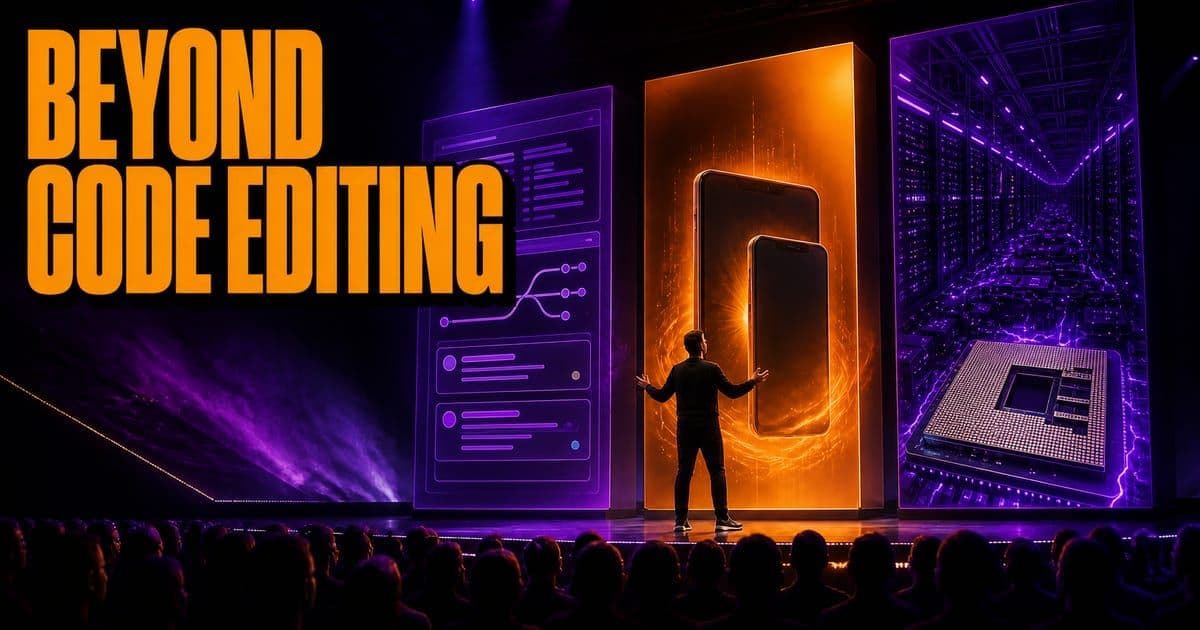
Cursor Compile 2026 was Cursor's first conference, held in San Francisco in June (press coverage dates it June 16). Its main product story was Cursor's move from an editor toward a broader system for software work, with Origin for code hosting, larger model training work and mobile access to agents.
On this page
- What did Cursor announce at Compile 2026?
- How should a team act on the Compile announcements?
- What should a team watch out for?
- Which Compile announcement should change what your team does this quarter?
- What do Cursor for iOS and Composer 2.5 change for a team?
- Why did a code-hosting product and a model announcement share one keynote?
- What does SpaceX buying Anysphere change for a buyer?
- What did Cursor not announce at Compile?
What did Cursor announce at Compile 2026?
Each Compile announcement had a different status. Origin opened as a waitlist and has since shipped in early beta, the larger model is training work rather than a product, and Cursor for iOS launched in public beta. The table gives the details for each.
- Release fact
- Event
- What to know
- Cursor's first conference, held in San Francisco for engineers, researchers and builders. Press coverage dates it June 16, and Cursor's Compile page gives no date.
- Release fact
- Origin
- What to know
- Cursor opened a waitlist for Origin, a code-hosting and review surface built for faster software work. Origin has been in early beta since August 17, 2026.
- Release fact
- Model work
- What to know
- Cursor's May 18 Composer 2.5The current Composer release, better at long-running tasks and at judging when a job needs a light touch versus deep work. Press Enter for the full definition. post says: "Together with SpaceXAI, we're training a significantly larger model from scratch, using 10x more total compute." The Compile recap on Cursor's community forum reported the same effort.
- Release fact
- Mobile
- What to know
- Cursor for iOS launched in public beta as a native app for starting, supervising, reviewing and merging agent work from an iPhone.
| Release fact | What to know |
|---|---|
| Event | Cursor's first conference, held in San Francisco for engineers, researchers and builders. Press coverage dates it June 16, and Cursor's Compile page gives no date. |
| Origin | Cursor opened a waitlist for Origin, a code-hosting and review surface built for faster software work. Origin has been in early beta since August 17, 2026. |
| Model work | Cursor's May 18 Composer 2.5The current Composer release, better at long-running tasks and at judging when a job needs a light touch versus deep work. Press Enter for the full definition. post says: "Together with SpaceXAI, we're training a significantly larger model from scratch, using 10x more total compute." The Compile recap on Cursor's community forum reported the same effort. |
| Mobile | Cursor for iOS launched in public beta as a native app for starting, supervising, reviewing and merging agent work from an iPhone. |
As of August 22, 2026, unless a row gives a later date. The sources are listed at the end of this page.
This is covered hands-on in Cursor Compile 2026 — 1 short Unit, free to read.
How should a team act on the Compile announcements?
Cursor's release notes and announcements say what changed. They don't say how a team should act on it. The steps below are our suggested order, and the next section lists what to watch out for along the way.
- 1Start from Compile: it frames the releases that followed it.
- 2Read the official Compile, Origin and Composer 2.5The current Composer release, better at long-running tasks and at judging when a job needs a light touch versus deep work. Press Enter for the full definition. pages before you trust a social media summary.
- 3Sort each announcement into available now, waitlist, beta or roadmap.
- 4Tie each announcement to the work it changes: code hosting, model choice, mobile control or team rollout.
What should a team watch out for?
Each item below is either a fact about the release, such as its beta status or plan access, or our advice for using it safely. Plan around each one, and recheck the facts when Cursor ships an update.
- Origin is not generally available. It has been in early beta since August 17, 2026, and Cursor has published no GA date, separate pricing or self-hosting.
- Base any claim about the iOS app on Cursor's current docs and blog, and treat Android as planned until Cursor ships it.
- Source model-training claims to Cursor's Composer 2.5The current Composer release, better at long-running tasks and at judging when a job needs a light touch versus deep work. Press Enter for the full definition. post until Cursor announces a newer model.
Which Compile announcement should change what your team does this quarter?
Cursor for iOS, Composer 2.5The current Composer release, better at long-running tasks and at judging when a job needs a light touch versus deep work. Press Enter for the full definition. and, since August 17, Origin are the ones you can act on. Cursor for iOS launched in public beta and runs on iPhone and iPad, and Composer 2.5 is available. Origin is in early beta, though not on the Free or Plus plans. All three can sit inside a real workflow this week. The larger model is training work, so the only move there is preparation.
That ordering matters. A roadmap written from Compile coverage tends to lead with Origin, because it carries the most obvious strategic weight. For two months the waitlist didn't open, so a team that led with Origin could watch a quarter pass while the work it could already do never got scheduled. Nobody logs that cost, because waiting doesn't show up anywhere. The beta is open now, and the trap has a new shape: the hosting basics shipped first, and the review features are arriving one at a time.
So sort the announcements by whether each one changes a loop you already run or a decision you haven't made yet. Composer 2.5The current Composer release, better at long-running tasks and at judging when a job needs a light touch versus deep work. Press Enter for the full definition. and the iOS app change loops. Origin's beta changes a loop only if you sync a repo and review on it. The decision Origin was announced to force, moving your hosting, still waits on the rest of those features and on a general-availability date, and the larger model is also a decision. A decision doesn't need a sprint.
Pending items still need a named owner and a review date. A calendar entry and one person who will notice when Cursor publishes something are enough. The Cursor Origin guide and the Cursor Mobile guide track those details as they arrive.
What do Cursor for iOS and Composer 2.5 change for a team?
The mobile app is the easiest announcement to underrate. Cursor for iOS is for starting, supervising, reviewing and merging agent work from a phone or, since July 29, an iPad. That reads like a convenience until you notice what it assumes. If a person can review and merge from a phone, review no longer requires a desk with the repo open, and that changes how your team works.
Check the requirements before you plan around it. Cursor's current docs put the app on iOS 26.0 and iPadOS 26.0 or later, and on plans that include Cloud AgentsAgents that run in a Cursor-managed virtual machine, check out the repo, do the work and open a pull request, then shut down, with no load on your laptop. Press Enter for the full definition.: Premium, Super, Ultra, Teams and Enterprise, plus the legacy Start, Pro, Pro+ and Ultra plans. Android is planned. The iPad release also added an Inbox, a full pull-request review surface, Bitbucket and Azure DevOps support, and multi-PR sessions.
Composer 2.5The current Composer release, better at long-running tasks and at judging when a job needs a light touch versus deep work. Press Enter for the full definition. is the plainer change. It is available today as a first-party Cursor model, and it puts a routing decision inside work you already do: which model plans and which one executes, given what each costs per run. A team can make that change on a Tuesday afternoon.
Why did a code-hosting product and a model announcement share one keynote?
Because both point at the same constraint from opposite ends. Cursor's Origin page argues that code is moving faster than the infrastructure built to handle it. The model work is about how fast and how cheaply that code gets written in the first place. The models govern how much code arrives, and Origin decides where it lands.
In the run-up to Compile, Cursor shipped things whose output is more diffs per hour: cloud agents, automations, BugbotCursor's automated PR reviewer that posts inline findings and can push fix commits from isolated VMs. Press Enter for the full definition. on pull requests, and review that runs without being asked. Ship enough of those and writing code stops being what holds you up. Review and merge become the bottleneck, and that is the layer Origin aims at. Cursor didn't own that layer until it agreed to acquire Graphite, a code review platform, in December 2025.
Whether those two halves need to belong to the same company is a separate question, and nothing at Compile settled it. A team can take the model story and keep its current host indefinitely.
The pairing still tells you how to read whatever comes next. When a Cursor release makes agents produce more change per hour, expect the following one to be about absorbing it. In practice, that has meant review that costs less and review that starts without a person asking for it. That is our guess about sequencing, not a roadmap. We would plan against it, because the other reading has Cursor shipping capacity it can't help you absorb.
What does SpaceX buying Anysphere change for a buyer?
Contractually, it may change a lot, and the filings don't say what. SpaceX agreed to buy Anysphere, Cursor's parent company, for $60B in stock, disclosed in an SEC 8-K dated June 16, 2026. Cursor announced the completed acquisition on August 14, 2026, in a post titled "Cursor is now a part of SpaceX." The deal closed three days before Origin's early beta opened.
Don't read product direction out of the ownership change. An 8-K tells you who owns the shares and since when. It says nothing about a data-retention setting or a support commitment.
The questions worth raising are the dull procurement ones, and they belong in your renewal thread rather than a strategy memo. Ask whether your agreement survives assignment to a new parent, and what notice you get if data-handling terms change. Ask who your named contact is after the close. Check whether anything you depend on today was scoped to Anysphere specifically as the counterparty.
None of those can be answered from a press release, so ask them well before your next renewal date.
If you are mid-procurement, the closed acquisition is no reason to pause and no reason to hurry. Put the August 14 close date next to your renewal dates and move on.
What did Cursor not announce at Compile?
The gaps matter as much as the announcements, and a recap is where they get lost. Cursor did not publish these four things at Compile, and each item notes what has changed since:
- A launch date for Origin. Coverage pointed at a fall 2026 window, but the early beta arrived on August 17, 2026, and a general-availability date is still unpublished.
- Any Origin pricing. There is still no separate price. The beta comes with Premium and higher, Teams, Enterprise and the legacy Start, Pro, Pro+ and Ultra plans, not with Free or Plus, and there are no post-beta terms.
- Android. The mobile release is iOS and, since July 29, iPadOS. Cursor's docs say Android is planned, so treat it as unshipped until Cursor says otherwise.
- Availability for the larger model. Cursor's Composer 2.5The current Composer release, better at long-running tasks and at judging when a job needs a light touch versus deep work. Press Enter for the full definition. post describes training work with SpaceXAI and 10x more total compute, which is not a release.
Write those gaps down, because a recap page is where someone else's assumption turns into a plan. A reader sees "Cursor announced Origin", hears "Origin exists", and it goes on a slide with a date next to it.
In June, the waitlist was all a buyer could see of Origin. Today Origin is an early beta with docs at cursor.com/docs/origin, and Cursor for iOS has a product page and an iPad layout. When a status like that changes, update the sentence instead of softening it.
Frequently asked questions
Who is this guide for?
Developers, team leads and buyers who follow Cursor's biggest 2026 announcements.
What should I do next?
Check the release facts above against the Cursor sources at the end of this page, then work through the steps in order.
When and where was Cursor Compile 2026?
In San Francisco, in June 2026. Press coverage dates it June 16, and Cursor's Compile page gives no date. It was Cursor's first conference, for engineers, researchers and builders, and Cursor has since taken Compile on the road to London and New York.
Is Cursor Origin available yet?
Origin has been in early beta since August 17, 2026, and it isn't available on the Free or Plus plans. Cursor opened a waitlist for it at Compile, and it has published no general-availability date, separate pricing or self-hosting option.
Did Cursor release a new model at Compile 2026?
No. Cursor's May 18 Composer 2.5 post says it is training "a significantly larger model from scratch" with SpaceXAI, using 10x more total compute, but that is training work, not a release. Composer 2.5 is the model you can use today.
Sources & last verified
- Cursor Compile
- Cursor Origin
- Cursor blog: Introducing Composer 2.5
- Cursor Community Forum: Compile 2026 announcements
- eesel: What is Cursor Origin? (Compile coverage)
- Cursor blog: Cursor on web and mobile
- Cursor docs: Cursor for iOS
- Cursor blog: Build from anywhere with Cursor for iOS
- Cursor docs: Origin
- Cursor changelog: Cursor for iPad
- Cursor blog: Cursor is now a part of SpaceX (Aug 14)
- Cursor blog: Graphite is joining Cursor (Dec 19, 2025)
Cursor ships frequently. Facts verified against primary sources on October 28, 2026.